Peechi Dam was designed by a man who held the title of Prime Minister of a country that no longer exists — E. Ikkanda Warrier headed the government of the short-lived independent state of Kochi before it merged into what would eventually become Kerala. Even more striking, when Warrier tried to build his dam, Kerala’s own engineers refused to have anything to do with the project, forcing him to import a retired chief engineer from Andhra Pradesh just to get construction underway.
Peechi Dam: Overview
| Parameter | Details |
| State | Kerala |
| District | Thrissur |
| Location | Peechi village |
| Distance from Thrissur city | Approx. 22–23 km |
| River | Manali River |
| Dam type | Concrete straight gravity dam |
| Height | 49.8 metres (163 ft) |
| Length | 213 metres (699 ft) |
| Base width | 4.27 metres (14 ft) |
| Construction began | 1947 |
| Inaugurated | 4 October 1957, by Burgula Ramakrishna Rao, Kerala’s first Governor |
| Fully completed | 1959 |
| Designed/championed by | E. Ikkanda Warrier, first Prime Minister of the independent state of Kochi |
| Operator | Kerala Irrigation Department |
| Catchment area | Approx. 3,200 acres (1,300 ha) |
| Irrigation coverage | Up to 17,555 hectares across Mukundapuram, Thrissur, Thalappilly, and Chavakkad taluks |
| Other purpose | Drinking water supply for Thrissur city |
| Adjacent protected area | Peechi-Vazhani Wildlife Sanctuary, established 1958 |
| Status | One of the oldest dams in Kerala |
| Best time to visit | October to February |
The Manali River and Thrissur’s Post-Independence Water Needs
Peechi Dam is built across the Manali River, a modest but significant waterway feeding the fertile paddy-growing plains surrounding Thrissur. Construction began in 1947, the very year of India’s independence, reflecting how quickly this region moved to address its agricultural and drinking water needs in the immediate post-colonial period.
A few points about this timing and setting:
- The dam’s catchment area spans roughly 3,200 acres, feeding a reservoir that would go on to become central to Thrissur’s water security for decades
- Its location within the broader Peechi-Vazhani forest landscape places it at the edge of genuinely significant Western Ghats biodiversity, with elephants regularly visible along the reservoir’s banks
- The project’s 1947 origins make it one of the earliest major water infrastructure undertakings in the newly reorganising political landscape of what would eventually become Kerala state
A Prime Minister From a State That No Longer Exists
Peechi Dam’s origin story is inseparable from one of the more obscure chapters of Indian political geography. E. Ikkanda Warrier (1890–1977) served as the first Prime Minister of the independent state of Kochi — a brief, constitutionally distinct political entity that existed during India’s post-independence transitional period, before eventually merging with Travancore to form Travancore-Cochin, and later becoming part of the modern state of Kerala following the 1956 States Reorganisation.
Warrier was the driving force and architect behind Peechi Dam, championing the project during his tenure leading this now-defunct state government. A few points about this historical context:
- Kochi’s brief existence as its own constitutional entity is a detail many people outside Kerala’s own political history are unaware of, making Peechi Dam a genuinely rare piece of infrastructure tied directly to a government that no longer exists in any form
- Warrier’s leadership of this project reflects the genuine urgency post-independence administrations felt to deliver visible, practical infrastructure benefits to their populations, even amid the broader uncertainty of ongoing state reorganisation
- The dam was formally inaugurated in 1957 by Burgula Ramakrishna Rao, serving as Kerala’s first Governor, with full construction completion following in 1959 — meaning the ceremonial opening preceded the project’s actual finishing by roughly two years
Built Against Local Opposition: Why Kerala’s Own Engineers Refused
Perhaps the most surprising detail in Peechi Dam’s history is the genuine local resistance it faced — resistance that came not just from residents but from within Kerala’s own engineering establishment. According to documented accounts, the majority of Thrissur’s population (“Thrissukkar”) opposed the dam’s construction, with this opposition cutting across political party lines rather than following any single faction.
More strikingly, Kerala’s own engineers refused to be involved in building the project. A few points about how this was resolved:
- Faced with this internal professional resistance, Warrier brought in a retired chief engineer from Andhra Pradesh specifically to lead the dam’s construction
- This detail reflects a genuinely unusual case of a state government needing to source external technical leadership because its own engineering community declined to support a major infrastructure project
- The specific reasons behind Kerala’s engineers’ opposition aren’t extensively documented in accessible public records, though such resistance often reflected genuine technical, environmental, or political concerns about large-scale water projects during this formative era of Indian state planning
Despite this considerable internal and public opposition, the project proceeded to completion, and Peechi Dam went on to become one of the more consequential pieces of water infrastructure in Kerala’s early post-independence development.
Engineering Specifications
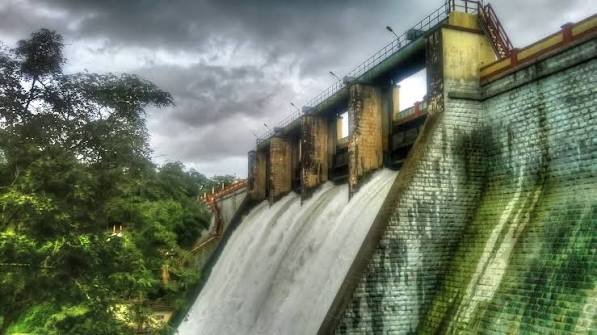
Peechi Dam is built as a straight concrete gravity structure, standing 49.8 metres (163 ft) tall and stretching 213 metres (699 ft) in length, with a base width of 4.27 metres (14 ft).
Core specifications:
- Height: 49.8 metres (163 ft)
- Length: 213 metres (699 ft)
- Base width: 4.27 metres (14 ft)
- Dam type: concrete straight gravity
- Catchment area: approximately 3,200 acres (1,300 ha)
This straightforward concrete gravity design, while less structurally elaborate than the arch dams built elsewhere in Kerala around the same era, was specifically suited to withstanding the region’s substantial monsoon rainfall while providing reliable, long-term structural durability.
What the Dam Irrigates and Supplies
Once completed, Peechi Dam delivered on its core mandate substantially, irrigating up to 17,555 hectares of paddy fields across four taluks:
- Mukundapuram
- Thrissur
- Thalappilly
- Chavakkad
Beyond irrigation, the dam also became a significant source of drinking water for Thrissur city itself, giving it a genuinely dual civic role from its earliest years of operation — a pattern that would later be echoed at the nearby Vazhani Dam, built within the same broader wildlife sanctuary landscape.
Inside the Peechi-Vazhani Wildlife Sanctuary
Peechi Dam sits at the heart of the Peechi-Vazhani Wildlife Sanctuary, established in 1958 and covering 125 sq. km — a designation that came just one year after the dam’s formal inauguration, reflecting deliberate, early conservation planning alongside the region’s water infrastructure development.
A few points about this ecological setting:
- Elephants can regularly be seen along the reservoir’s banks, one of the sanctuary’s most notable wildlife draws for visitors
- The sanctuary’s establishment so soon after the dam’s completion suggests a genuine, coordinated approach to balancing infrastructure development with forest conservation in this stretch of Thrissur district
- This combination of a historically significant dam and an adjacent wildlife sanctuary has made Peechi one of Thrissur’s most consistently popular day-trip destinations
Planning a Visit to Peechi Dam
For anyone considering a trip:
- Getting there: The dam sits roughly 22–23 km from Thrissur city, accessible by road
- Best season: October through February offers the most comfortable weather and typically the fullest reservoir following the monsoon
- What to see: Boating facilities on the reservoir, combined with the surrounding wildlife sanctuary’s elephant sightings, make for a well-rounded day trip
- Historical interest: Visitors interested in Kerala’s early post-independence political history may find genuine added value in learning about E. Ikkanda Warrier’s role and the brief, now largely forgotten state of Kochi before exploring the dam itself
FAQs
Q1. What was the independent state of Kochi, and does it still exist today?
Kochi was a distinct constitutional state that existed briefly during India’s post-independence transitional period, with E. Ikkanda Warrier serving as its first Prime Minister, before it merged with Travancore to form Travancore-Cochin and was later incorporated into the modern state of Kerala following the 1956 States Reorganisation.
Q2. Why did Kerala’s own engineers refuse to help build Peechi Dam?
While the specific detailed reasons for this professional opposition aren’t extensively documented in accessible public records, it was significant enough that project architect E. Ikkanda Warrier had to bring in a retired chief engineer from Andhra Pradesh to lead construction after Kerala’s engineering establishment declined to support the project.
Q3. Why was Peechi Dam inaugurated in 1957 but not actually completed until 1959?
This two-year gap reflects a common pattern in large Indian infrastructure projects of the era, where a ceremonial inauguration marking the dam’s functional opening preceded the full completion of all remaining construction and finishing work.
Q4. Can visitors see wild elephants at Peechi Dam, or is that mainly at the nearby Vazhani Dam?
Elephants can regularly be spotted along the banks of the Peechi reservoir itself, since the dam sits within the broader Peechi-Vazhani Wildlife Sanctuary, making elephant sightings a genuine possibility at either location within this shared protected forest landscape.