When Hyderabad’s water planners looked upstream on the Manjira River for a new drinking water source in the 1970s, the water they wanted was already entirely committed to agriculture — most of it flowing further downstream to feed the historic Nizam Sagar Dam’s farmland. What followed was a genuinely consequential reallocation: a decade of political negotiation that ultimately redirected Manjira water toward a rapidly growing city, at the direct expense of the older, agriculture-dependent reservoir sitting further down the same river.

Singur Dam: Overview
| Parameter | Details |
| State | Telangana |
| District | Sangareddy |
| Location | Singooru village, Pulkal mandal |
| Official name | M BhagaReddy Singur Project |
| River | Manjira River, a tributary of the Godavari |
| Dam type | Earthen/gravity, with central concrete spillway |
| Height | 33 metres |
| Length | 7,520 metres (24,670 ft) |
| Construction began | 1979 |
| Water withdrawals began | 1991 |
| Conveyance system completed | Two phases: 1991 and 1993 |
| Dam formally completed | Sources cite 1989 to 1998 |
| Spillway | 17 radial gates, discharge capacity 8.16 lakh cusecs |
| Reservoir total capacity | 30 TMC ft (approx. 850 million cubic metres) |
| Reservoir active capacity | Approx. 20–29 TMC ft, depending on source |
| Purpose | Irrigation, hydroelectric power, drinking water |
| Primary role | Major drinking water source for Hyderabad city |
| Water supplied to Hyderabad annually | Approx. 10 TMC ft |
| Notable incident | October 1999 — one of 17 spillway gates failed during initial filling |
| Downstream related dam | Nizam Sagar Dam, on the same Manjira River |
| Status | Irrigation component in Medak district remains incomplete |
| Best time to visit | October to February |
The Manjira River and a Contest Between Farms and a Growing City
Singur Dam is built across the Manjira River, which originates in Maharashtra and flows through Karnataka and Telangana before joining the Godavari. This same river, further downstream, feeds the much older Nizam Sagar Dam — meaning Singur and Nizam Sagar are directly connected pieces of the same water system, competing for the same finite Manjira flow.
A few points about this relationship:
- Nizam Sagar, completed in 1931, was built specifically to irrigate farmland across several Telangana taluks, and by the time Singur was conceived decades later, essentially all of the Manjira’s available water was already committed to that agricultural purpose
- Singur Dam’s construction therefore represented a genuine reallocation of an already fully utilised water resource, diverting flow toward Hyderabad’s urban drinking water needs rather than expanding agricultural capacity
- This upstream positioning means water captured and diverted at Singur directly reduces the volume reaching Nizam Sagar’s reservoir further downstream, a dynamic that has likely compounded the severe siltation-driven capacity losses Nizam Sagar has separately experienced over the decades
History: How Hyderabad’s Water Needs Reshaped the Manjira
Hyderabad’s dependence on the Manjira for drinking water predates Singur Dam considerably. Water from an earlier Manjira reservoir scheme was first conveyed to the city in 1965, but as Hyderabad’s population and water demand continued growing rapidly following the formation of Andhra Pradesh, this supply proved insufficient.
In 1972, the Government of Andhra Pradesh appointed the Sreenivasarao expert commission specifically to recommend options for augmenting Hyderabad’s water supply, having ruled out groundwater as inadequate and pollution-prone. What followed was a genuinely significant political process:
- In 1975 and 1978, the Andhra Pradesh government signed separate agreements with Maharashtra and Karnataka regarding Manjira water allocation, proceeding despite the water already being entirely committed to existing agricultural use
- Construction of Singur Dam began in 1979, with a design storage capacity of approximately 850 million cubic metres (30 TMC ft)
- The system to actually convey this water to Hyderabad was completed in two phases, in 1991 and 1993, with water withdrawals beginning in 1991
- This reallocation has been academically characterised as the result of a decades-long institutional process of political decision-making that ultimately prioritised Hyderabad’s urban growth over longer-established agricultural water rights
Singur remained Hyderabad’s largest single water source until 2005, when the city began drawing additional supply from the Nagarjuna Sagar reservoir on the Krishna River itself, located over 135 km south and requiring a pumped lift exceeding 400 metres in elevation — a far more energy-intensive water source that only became necessary once Singur’s contribution alone could no longer meet the city’s continued growth.
The 1999 Gate Failure: A Close Call During First Filling
Singur Dam’s early operational history includes a genuine structural incident worth documenting. In October 1999, during the initial filling of the reservoir — with water levels still about 9.8 feet (3 metres) below the dam’s full design level — one of the dam’s 17 radial spillway gates failed.
A few details of this incident:
- The gate became dislodged after a detachment of its left-side trunnion girder
- The right-side arm continued supporting the gate for approximately 22 hours before it too became completely dislodged and washed away
- Andhra Pradesh state authorities attributed the failure to inadequate welding between the trunnion girder and the tie flats supporting it
- No downstream damage was reported as a result of this failure
This incident, occurring during the reservoir’s very first filling cycle before it had even reached full design capacity, serves as a useful reminder that even well-planned dam projects can encounter genuine structural issues during their initial operational testing phase.
Engineering Specifications
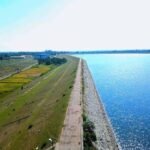
Singur Dam is built as an earthen structure with a central concrete spillway, standing 33 metres tall and stretching 7,520 metres (24,670 ft) in length — a considerable span reflecting the relatively open valley terrain the dam needed to close off near Singooru village.
Core specifications:
- Height: 33 metres
- Length: 7,520 metres (24,670 ft)
- Spillway: 17 radial gates, discharge capacity 8.16 lakh cusecs
- Reservoir total capacity: 30 TMC ft (approximately 850 million cubic metres)
- Reservoir active capacity: 20–29 TMC ft, depending on the specific source
What the Dam Supplies Today
Singur Dam’s core role remains supplying drinking water to Hyderabad, though the mechanism involves a genuinely notable inter-basin water transfer:
- The dam feeds a pipeline scheme that transfers Godavari basin water (via the Manjira) into the Krishna river basin, where Hyderabad city itself sits
- Approximately 10 TMC ft of water is supplied to Hyderabad annually from this reservoir
- Roughly 80% of this water, after municipal use, becomes regenerated sewage flow that is subsequently redirected for irrigation purposes downstream
- The dam currently supplies an estimated 30% of Hyderabad’s total drinking water needs, though this share has diminished proportionally since 2005, as the city increasingly draws additional supply from the more distant Nagarjuna Sagar reservoir on the Krishna
An Incomplete Irrigation Promise
Despite irrigation being listed among Singur Dam’s original stated purposes, the irrigation component of the project within Medak district has never been fully implemented. This reflects what has been described as a history of delays affecting the project since its inception — the urban drinking water component was prioritised and completed, while the agricultural irrigation benefit that had originally helped justify the project has remained substantially unrealised for the local farming communities in its immediate command area.
Planning a Visit to Singur Dam
For anyone considering a trip:
- Getting there: The dam sits near Singooru village in Pulkal mandal, Sangareddy district, accessible by road from Hyderabad
- Best season: October through February offers comfortable weather and typically the fullest reservoir following the monsoon
- What to see: A popular tourist destination in its own right, offering scenic reservoir views for visitors from Hyderabad and the surrounding region
- Historical interest: Understanding the dam’s role in Hyderabad’s water history, and its connection to the older Nizam Sagar Dam downstream, adds genuine depth to what might otherwise be viewed as a purely scenic reservoir stop
FAQs
Q1. Does water diverted at Singur Dam directly affect farmers who depend on the older Nizam Sagar Dam downstream?
Since both dams draw from the same Manjira River, with Singur positioned upstream, water captured and redirected toward Hyderabad at Singur does reduce the flow reaching Nizam Sagar’s reservoir further downstream, compounding that older dam’s separate, well-documented siltation-driven capacity challenges.
Q2. Why does Singur Dam’s completion date vary so much between different sources — 1989, 1991, or 1998?
These different dates likely reflect distinct project milestones — the dam structure itself, the conveyance system delivering water to Hyderabad (completed in phases during 1991 and 1993), and various administrative completion certifications — rather than genuine factual disagreement about a single completion event.
Q3. Is Singur Dam still Hyderabad’s primary drinking water source today?
It remains a significant source, supplying around 30% of the city’s needs, but it has not been the largest single source since 2005, when Hyderabad began drawing substantial additional supply from the more distant Nagarjuna Sagar reservoir on the Krishna River.
Q4. Was anyone harmed by the 1999 spillway gate failure at Singur Dam?
No downstream damage or harm was reported as a result of the incident, which occurred during the reservoir’s initial filling phase before the dam reached its full design water level, and the failure was specifically attributed to inadequate welding in the gate’s support structure.